Introduction
In my previous article, I reviewed and critiqued Eric Metaxas’s book, Letter to the American Church, because it called on the “American” Church to engage with the world, but it did so without providing a foundation for the nature, mission, and work of the Church, nor for the nature, mission, and work of government.[14] This article will endeavor to provide those biblical foundations.
Properly so, there are many hundreds of books on this vast and complex subject. This article reflects what I have found to be a solid, biblically based approach, but it is by no means the only approach, and space limitations will restrict this article to being a high-level overview of this topic, but hopefully with enough detail to still be helpful for our church family.
Why This Matters
Knowing God’s intended purposes for the Church and the government, and how they are intended to interact with each other, is crucial. If we don’t have this foundation, then our efforts at best will be misguided and wasteful, and at worst, damaging to the cause of Christ. But if we have our foundation correct, then we can know we are living according to God’s revealed intentions, and we will be effective ambassadors for Christ.
An additional benefit is that we will be equipped with a biblical framework from which we can evaluate political candidates and issues. We can ask and answer questions such as:
- Which candidate or ballot measure will most effectively ensure that the government is passing laws and exercising its powers and authority —“the sword”—according to God’s design?
- Which candidate or ballot measure will most effectively guard the “straight-line” issues of biblical morality?[15]
- Which candidate or ballot measure will ensure that God’s intended purposes for the Church are being protected?
We will now examine the institution of the Church and the government from a biblical perspective.
The Nature, Mission, and Work of the Church
The Nature of the Church
This is a concise but comprehensive description of the nature of the Church.
The church has its roots in the promises made to God’s people in the Old Testament, particularly that God would bless the world through Abraham’s offspring. While there is continuity between the Old Testament people of God and the church, the church is the community of Jesus, new at Pentecost. As such, the church is the fulfillment of God’s promise to the prophets that he would make a new and better covenant with his people and write his law on their hearts.[16]
When Jesus preaches the Sermon on the Mount to his disciples and the crowds, he is explaining what life is to look like in this new community that he’s come to create. It is distinctly different from the Jewish culture of the time, and definitely different from the world. These are some (but not all) of the new ethics that are to distinguish the lives of the members of this new community. The poor, those who mourn, who are humble, who hunger and thirst for justice, who are merciful, whose hearts are pure, who work for peace and who are persecuted for doing right are blessed and the Kingdom of Heaven is theirs. (Matt. 5:3-10)
- Reconciliation and mercy over justice (Matt. 5:21-26, 38-42)
- Sexual purity over lust, and marriage fidelity over convenience (Matt. 5:27-32)
- Love of enemies over hate (Matt. 5:43-48,7:12)
- Spiritual authenticity over hypocrisy (Matt. 6:1-18, 7:1-6)
- Trust in God over your own capabilities (Matt. 6:19-34)[17]
When this community assembles locally it is called the church and it is where divine spiritual activities will occur, because Jesus is present. This is unique to the church.
- Exercising the keys of the kingdom (Matt. 16:18–19)
- Conducting discipline according to the Sermon on the Mount (Matt. 18:15–17)
- Preaching the gospel (2 Tim. 4:1–5)
- Baptizing and making disciples of Christ (Matt. 28:19–20)
- Worshiping corporately in song (Eph. 5:19; Col. 3:16)
- Celebrating the Lord’s Supper (1 Cor. 11:17–34)
- Ordaining ministers (1 Tim. 4:14; Titus 1:5–9)[18]
Notice the special nature of the ethics and the activities of this community, and how contrary they are to those in the world at large, or even the Jewish culture of Jesus’s time.
The Mission of the Church
To understand the mission for the Church we have to first understand the mission of Jesus, the Church’s Head.[19]
For the Son of Man came to seek and to save the lost. (Luke 19:10)[20]
The true light, which gives light to everyone, was coming into the world. He was in the world, and the world was made through him, yet the world did not know him. He came to his own, and his own people did not receive him. But to all who did receive him, who believed in his name, he gave the right to become children of God, who were born, not of blood nor of the will of the flesh nor of the will of man, but of God. (John 1:9-13)[21]
Jesus was sent by his Father to save the world, by making his Father known to the world, through trusting in the person and work of Jesus.
To be sure, there are significant additional facets to Jesus’ mission, but at the risk of minimizing this point, his work to save a lost and rebellious people and bring them into an eternal relationship with the Triune God is predominant.
The mission of the church is to continue Jesus’s mission.[22]
Now the eleven disciples went to Galilee, to the mountain to which Jesus had directed them. And when they saw him they worshiped him, but some doubted. And Jesus came and said to them, ‘All authority in heaven and on earth has been given to me. Go therefore and make disciples of all nations, baptizing them in the name of the Father and of the Son and of the Holy Spirit, teaching them to observe all that I have commanded you. And behold, I am with you always, to the end of the age.’ (Matt. 28:16-20)
God, in his unfathomable providence, has commanded, entrusted, and equipped his followers with the marvelous privilege of being instrumental in the work of growing God’s family, by going into all of the nations and making disciples. God sent Jesus and now Jesus sends us. And this is further revealed and confirmed as the mission of the church throughout the book of Acts, as the disciples obeyed Jesus’s Great Commission and made disciples of the world.[23] The Church’s mission is to be evangelists and to make disciples.
The Work of the Church
The works of the Church are numerous, and as we have learned through Pastor’s Matt’s excellent teachings on the book of Ephesians, chapter 4:11-16 arguably provides the most best description of the work that the local church is called to do for its members, in the service of Christ.[24]
And he (Jesus) gave the apostles, the prophets, the evangelists, the shepherds and teachers, to equip the saints for the work of ministry, for building up the body of Christ, until we all attain to the unity of the faith and of the knowledge of the Son of God, to mature manhood, to the measure of the stature of the fullness of Christ, so that we may no longer be children, tossed to and fro by the waves and carried about by every wind of doctrine, by human cunning, by craftiness in deceitful schemes. Rather, speaking the truth in love, we are to grow up in every way into him who is the head, into Christ, from whom the whole body, joined and held together by every joint with which it is equipped, when each part is working properly, makes the body grow so that it builds itself up in love. (Eph. 4:11-16)
Jesus has gifted the church with the ministers necessary to disciple and build the people of God’s family into Christlikeness and into a body unified by love. This is the primary work of the local church. And the New Testament Epistles written to the churches are principally about encouraging, correcting, teaching, instructing and training the members of churches to this end, for the glory of Christ.
In summary, the church is God’s ongoing fulfillment of his promise to create a people for himself, where the gospel is proclaimed and experienced through divine spiritual happenings, and where God’s gifted leaders equip and grow his church into a spiritually mature community that is being discipled and is making disciples, while loving one another.
The Nature, “Mission”, and Work of Government[25]
The Nature of Government
As American Citizens, we are very familiar (hopefully!) with these revolutionary words:
We hold these truths to be self-evident, that all men are created equal, that they are endowed by their Creator with certain unalienable Rights, that among these are Life, Liberty and the pursuit of Happiness. —That to secure these rights, Governments are instituted among Men, deriving their just powers from the consent of the governed,[26]
As Americans, our founding Fathers and founding documents declare that the unalienable rights men have come from our Creator, and to ensure that these rights are protected, a government has been created by men which derives its powers from the mutual consensus of those people who are forming the government. In other words, the people create a government, and they willingly agree to transfer power to this government, and to then obey this government’s appropriate exercise of that delegated power over their lives.
But the Scriptures teach that government is an institution created by God not by men, and the power that it has comes from God. This appointment can be seen in Genesis 9, after Noah and his family emerged from the ark after the destruction of the flood.
And for your lifeblood I will require a reckoning: from every beast I will require it and from man.
From his fellow man I will require a reckoning for the life of man.
‘Whoever sheds the blood of man,
by man shall his blood be shed,
for God made man in his own image.’
And you, be fruitful and multiply, increase greatly on the earth and multiply in it.[27]
Note that God uses the phrase “I will require” three times. God is the authority behind the delegated authority he gives to worldly government and to whom governments ultimately answer. But it will be the government that will be the one exercising this reckoning, on God’s behalf. This is God’s decree for the creation of government and for government to have the right to use force against its citizens, but only in a proportional manner.[28]
The Mission of Government
From Genesis 9, we can then deduce three God ordained primary purposes for government—its mission.
First, to render judgment for the sake of justice. Justice executed is to be proportional to the crime. “A life for a life.” This authorizes tremendous power to government—the ability to take a life—but it also limits government so that it doesn’t overstep its authority. Implicit in this command is that governments should protect the lives of its citizens. The life of a citizen is so valuable that if someone takes a life, their life is forfeited. Therefore, those lives must also be protected from harm, whether from other citizens or invaders.
Second, to build platforms of peace, order, and flourishing. The provisions for the government to provide justice and safety in vv. 5-6 are the necessary prerequisites for being able to fulfill the command to (re)populate the earth in v. 7. “By justice a king builds up the land.” (Pro. 29:4; also, 16:12, 15). In other words, governments exist to build a platform on which human beings can pursue God’s dominion mandate.29
And we see this same principle taught by Paul to Timothy:
First of all, then, I urge that supplications, prayers, intercessions, and thanksgivings be made for all people, for kings and all who are in high positions, that we may lead a peaceful and quiet life, godly and dignified in every way. (1 Tim. 2:1-2)
Third, to set the stage for redemption. Paul first says we are to pray for our leaders so that we may lead a peaceful and quiet and godly life. Here is the rest of Paul’s teaching:
This is good, and it is pleasing in the sight of God our Savior, who desires all people to be saved and to come to the knowledge of the truth. (1 Tim. 2:3-4)
When we follow vv. 1-2, vv. 3-4 we then enable “people to be saved and come to the knowledge of the truth”, and this happens primarily through the exemplary lives of Christians, who are free to live and worship as Christians and evangelize their neighbors, who are also free to then live out their Christian lives.[30]
People must learn to read before they can read the Bible. People must eat healthy food and breathe nontoxic air so that they can live, “that they may know God, and worship him. Children benefit by having loving parents so that they can better apprehend the love of God the Father. Do you see? God means for the stuff of ordinary, everyday life to serve the purposes of salvation and eternity.[31]
So, the mission for the government, ultimately, is to support the mission of the church.
The Work of the Government
One of the primary ways in which government fulfills its mission, as described above, is to “wield the sword.” We first saw this in Genesis 9, where God requires a reckoning. And then Paul teaches the same principle.
For rulers are not a terror to good conduct, but to bad. Would you have no fear of the one who is in authority? Then do what is good, and you will receive his approval for he is God's servant for your good. But if you do wrong, be afraid, for he does not bear the sword in vain. For he is the servant of God, an avenger who carries out God's wrath on the wrongdoer. (Rom. 13:3-4)
Having the authority to punish and hold people accountable to the law is the instrumentation that the government brandishes “to protect life, enable the cultural mandate, and provide a platform for the work of the church.”[32]
And Peter then teaches that we are to submit to this action.
Be subject for the Lord's sake to every human institution, whether it be to the emperor as supreme, or to governors as sent by him to punish those who do evil and to praise those who do good. For this is the will of God, that by doing good you should put to silence the ignorance of foolish people. (1 Pet. 2:13-15)
Conclusion
God has established both institutions—the Church and the government—and granted them authority in two different realms. The church has been given the “keys to the kingdom” and the government has been given the power of “the sword”. Each institution is designed to exercise its authority in its own realm and to not exercise authority in the other.
For example, it is not within the purview of the church to punish people outside the church for breaking the law or for theological heresy. And it is not within the purview of the government to establish how people are to worship God or to hold people accountable for their theology.
Ultimately, both governments and churches serve God’s purpose of calling all people to worship him, the former indirectly, the latter directly. The government’s work is a prerequisite to the mission of the church and salvation, just as learning to read is a prerequisite to reading the Bible.[33]
However, this does not mean that these two institutions are to never associate, in fact, it is inevitable that they will. And now that we have established a biblical basis for the nature, mission, and works of these two complementary organizations (see Fig. 1 following for a helpful chart), in our next series of articles, we will address how they are intended to interact, and how we as Christians, are intended to act in relation to both.
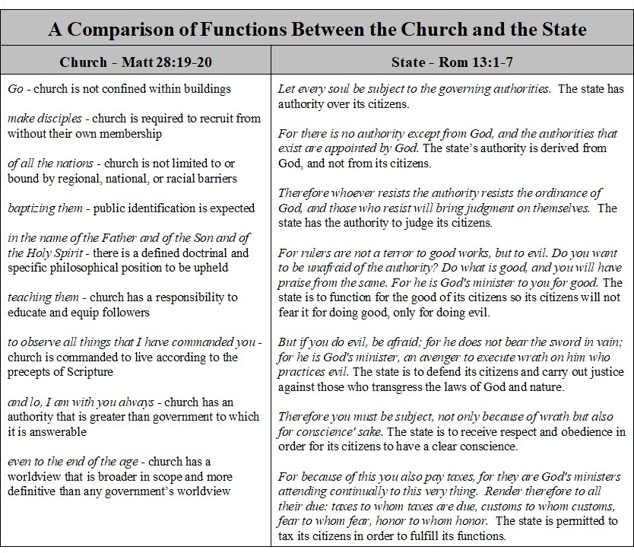
Fig. 1. A Comparison of Functions Between the Church and the State from: Button, Stephen.
Footnotes
[14] Strictly speaking, Metaxas’s book was addressing Christian engagement with the broader subject of “the world”, not only the government. But this article will broach the larger topic of Christian engagement with the world by beginning with the government, which was an emphasis by Metaxas. Additional aspects of “the world” will be covered in subsequent articles.
[15] Kottman, Matt. “Politics and the Unity of the Church.” Solid Rock Christian Fellowship: Keeping in Touch Newsletter, June 2024. Contact the church office if you’d like a copy.
[16] Morgan, C. (2021, February 10). The origin and nature of the church. The Gospel Coalition. https://www.thegospelcoalition.org/essay/origin-nature-church/. The author is summarizing numerous Scriptures, but particularly Jer. 31; Rom. 11:27; Heb. 8:8-12, 10:16-17; by allusion Matt. 26:28; Mark 14:24; John 6:45
[17] David VanDrunnen, Living in God’s Two Kingdoms: A Biblical Vision for Christianity and Culture (Illinois: Crossway Books, 2010), chap. 6, Kindle.
[18] VanDrunnen. Ibid.
[19] Eph. 5:23; Col. 1:18
[20] All Scripture quoted is ESV.
[21] See also John 3:16-17, 17:1-3
[22] DeYoung, K. (2024, March 27). The mission of the church. The Gospel Coalition. https://www.thegospelcoalition.org/essay/the-mission-of-the-church/
[23] Ibid.
[24] Pastor Matt Kottman. “Church Unity and Maturity.” November 19, 2023. https://vimeo.com/886634696
[25] Jonathan Leeman, How the Nations Rage: Rethinking Faith and Politics in a Divided Age (Tennessee: Nelson Books, 2018), chap. 5, Kindle. I am indebted to Mr. Leeman for providing much of the content for this section. I have relied on it heavily because it is the best treatment on this subject that I have found.
[26] Declaration of Independence: a transcription. (2023, October 11). National Archives. https://www.archives.gov/founding-docs/declaration-transcript
[27] Gen. 9:5-7
[28] See also Rom. 13:1-7; Titus 3:1-2
[29] Leeman. Ibid.
[30] Of course, God works through cultures where this isn’t the case, but that is necessitated due to the government’s disobedience to God’s decrees. God’s Providence works in spite of and through the world’s disobedience (and ours).
[31] Leeman. Ibid.
[32] Ibid.